Subterranean termite pressure in Pulaski County intensifies along the Arkansas River valley, where red clay soil balances high annual rainfall with humid seasonal shifts. In older established neighborhoods like…
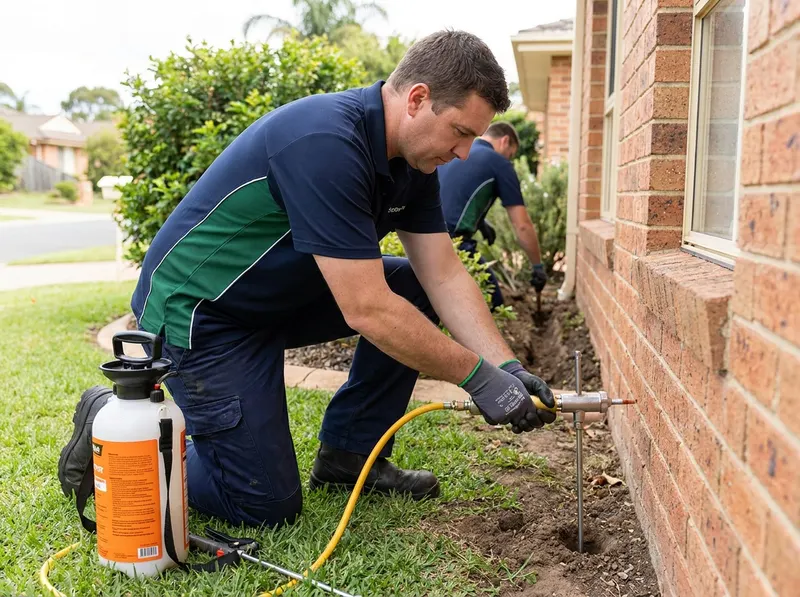
Subterranean termite pressure in Pulaski County intensifies along the Arkansas River valley, where red clay soil balances high annual rainfall with humid seasonal shifts. In older established neighborhoods like Hillcrest, Stifft Station, and The Heights, historic homes built over ventilated crawlspaces frequently lack modern physical capillary breaks. In these structures, native subterranean colonies construct mud tubes across damp perimeter masonry to reach band joists, subfloors, and sill plates. Properties bordered by mature tree canopy near Riverdale or Boyle Park face elevated colony density because decaying subsurface taproots provide satellite foraging zones directly adjacent to residential slab footings.
Establishing an undetectable non-repellent chemical barrier functions differently than surface pest control sprays. Surface sprays merely deter worker termites on contact, which prompts the colony to exploit alternate unseen entry fractures. Liquid soil treatment utilizes active agents such as fipronil applied at labeled dilutions of 0.06% to 0.125% per 10 linear feet. As foraging termites pass through the treated continuous soil trench, they ingest and mechanically transfer the non-repellent material throughout the central subterranean colony through social grooming, neutralizing the reproductive queen rather than just localized scout workers.
Slab foundations common in Chenal Valley, Pleasant Valley, and Broadmoor present specific treatment geometry where garage aprons and exterior aggregate walkways abut the foundation plate. Technicians mechanically drill 1/2-inch holes spaced roughly 12 inches apart through exterior concrete to inject liquid termiticide directly into the underlying aggregate bed before backfilling with non-shrink hydraulic cement. For homes situated near steep rocky drainage corridors around Cammack Village and Capitol View, exterior perimeter trenching must reach down 6 inches into stable subsoil or down to the top of the concrete footing to prevent subsurface runoff from dispersing the active chemical band during heavy spring cloudbursts.
Every job gets a firm, written price after a free on-site visit.
Tell us about your subterranean termite barrier treatment job in Rock and we'll send a clear, written quote, usually the same day.
 Miresto Pest Guard